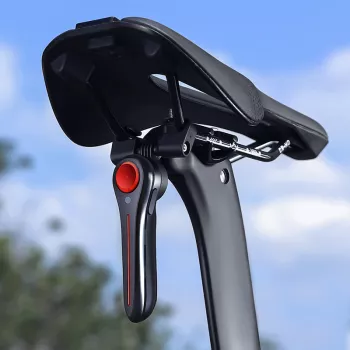
A taillight should do more than blink—it should communicate. Our smart bike taillight pairs a bright, high-visibility LED with a brake-sensing function that helps signal speed changes to people behind you. It’s a simple upgrade that adds clarity to everyday rides: commuting at dusk, rolling through shaded streets, or finishing a route after sunset.
If you want to make your riding more readable—especially in stop-and-go traffic or on shared paths—start with a rear light that’s easy to mount, quick to understand at a glance, and consistent ride after ride.
A “smart” taillight earns that label when it reduces guesswork for the person following you. Instead of relying on a single steady output, it reacts to what you’re doing.
If you’re ready to upgrade your rear visibility, you can start with our Smart Bike Taillight with Brake Sensor and High-Visibility LED.
Following traffic reacts to contrast and timing. When your speed drops, a brake-responsive pattern makes that change more obvious—especially when the person behind you is scanning for multiple hazards at once.
Brightness is only one piece of being noticed. A taillight has to stay readable in messy backgrounds—streetlights, headlights, illuminated signs, and other vehicles’ taillights.
For broader safety guidance, you can also review resources from NHTSA and the CDC.
Even a strong taillight can underperform if it’s pointed the wrong way or blocked by gear. A few quick setup habits go a long way.
Make your rear light part of your “keys-wallet-phone” routine so it stays consistent.
If you’re deciding whether brake sensing and high-visibility output match your riding, map features to your most common conditions.
| Riding scenario | Helpful taillight feature | Why it helps |
|---|---|---|
| Stop-and-go commuting | Brake-sensing signal | Makes deceleration clearer at short following distances |
| Evening neighborhood rides | High-visibility LED | Improves detection against dim backgrounds |
| Shared paths and group rides | Distinct flash/steady options | Helps others read your position and pace |
| Rainy or hazy conditions | Attention-grabbing pattern | Cuts through reduced contrast and glare |
Your rear light works best as part of a system. You don’t need complexity—just coverage that makes you easier to interpret from multiple angles.
Want a quick add-on for daily routines beyond your bike kit? Our team also keeps a small set of practical, in-stock picks available, including Cozy Polka Dot Plush Dog & Cat Winter Coat, Elegant Round Cream Coffee Table, and Fee Structure Steps.
A brake sensor taillight detects deceleration or motion changes and triggers a brighter brake-style signal when you slow down. It typically works without connecting to your bike’s brake cables, so it can add a braking cue through built-in sensing.
Mount your rear light in a stable, centered position—commonly on the seatpost or near the seat-stay area—so it stays aligned and doesn’t wobble. Keep it level and make sure bags or clothing don’t block the beam from behind.
Blinking modes can be easier to notice in busy traffic, while steady modes can help others judge your distance and speed more naturally. Many riders switch modes based on conditions and local rules, using higher-attention patterns in traffic and simpler signals on calmer routes.










Leave a comment